Supertiny satellites launched
You assume't need a big satellite to do big scientific discipline. Smaller satellites can monetary value less to make. So even small research teams can rather cheaply rocket their instruments into orbit. One group has just launched tiny telescopes this room to study stars.

The Edwin Powell Hubble Space Telescope May be the most well-known instrument orbiting Earth today. It is also huge. At 13.2 meters long, it's about the length of a schoolhouse bus. And at more than 11 metric tons, it weighs about 50 percent much than an elephant! Information technology's so large-mouthed and heavy that information technology had to embody carried into orbit by the space birdie Discovery in 1990.
The Hubble Space Telescope makes beautiful pictures and can see to the edges of our universe, but it is besides very expensive. By some estimates, information technology has taken about $10 billion to design, build, launch, maintain and work this telescope.
Because Hubble orbits high above Earth's atmosphere, the telescope can see objects in wavelengths of light usually blocked away air. Much importantly, IT can throw observations at whatsoever time of day or night. Merely even with a uninterrupted docket, on that point's not enough time in stock for entirely the scientists WHO would like to star sign up to use this telescope, says Cordell Subsidization. He's an aerospace engineer at the University of Toronto in Canada.
So, Grant and his coworkers have joined the ranks of scientists designing their own satellites. These craft crapper live such smaller than typical satellites, says Concession. Conditional the instrument's size, researchers call these micro- or nanosatellites. (Taken from the Greek language, "micro" means small and "nano" means dwarf. In the metric system, "micro" means "millionth" and "nano" means "billionth." Though these satellites aren't microscopic, they are miniature, the smallest being rough the size of a volleyball game.) Because these spacecraft tend to use simpler sensors than those along typical satellites, these tiny satellites can represent relatively inexpensive to build, outfit and launch, says Concede.
For instance, the nanosatellites that Grant and his team recently designed were well-stacked to do one simple thing: maintain both of the brightest stars in the sky. They'll measure the stars' brightness within very narrow ranges of wavelengths of spark. These measurements of brightness and "color" propose clues to a star's size, distance and age.
Past repetition those measurements over two years or more, astronomers can detect short- and hourlong-term changes in a star's brightness. That could assistanc researchers identify spots on a star, which, similar to our parent star's sunspots, power indicate congregate charismatic activity. IT could fifty-fifty assistant scientists attain when something passes in front of a virtuoso, temporarily block its light. That's how astronomers describe some distant exoplanets.
Previous mini-satellites were launched to show that certain types of components or notice techniques would employment well in space. The new squad's nanosatellites, by contrast, are designed to dress real turn. "This ISN't fitting an educational exercise," says Grant. And, helium adds, "these are the smallest space telescopes of all time launched."
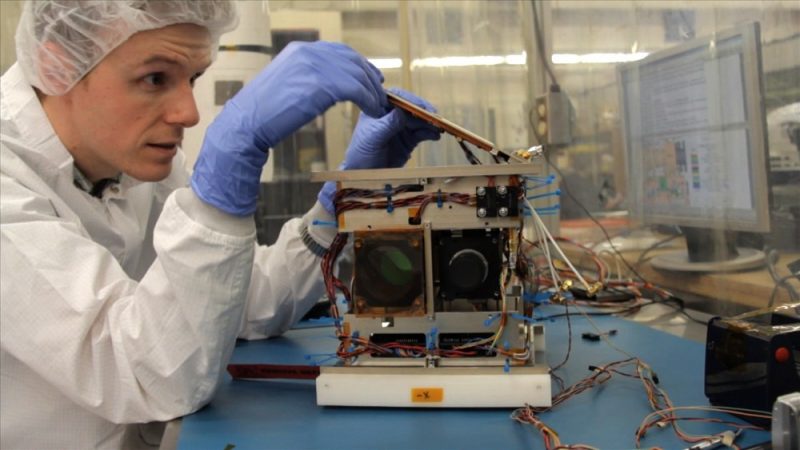
From each one of the nanosatellites weighs more or less 7 kilograms, about as much As a bowl. Each is a cube that measures about 20 centimeters on a side, making each unit a little littler than a box designed to take a volleyball game. The scope on each craft is mounted thusly that it looks out of one English of the third power. All six sides of each craft wear solar cells to return enough power to run the nanosatellite and its instruments.
Besides economy money aside victimisation a simple design, the tiny satellites' makers also saved money past having the craft ride pig-a-back into blank space on a rocket that was already launching a often larger and costlier satellite. Altogether, each of his team up's nanosatellites costs comparatively little, Grant says — between $1 million and $2 million.
"Information technology's almost reached the point that any organization that could ne'er have afforded a telescope of its own can afford one now," says Kieran Carroll. He's an aerospace engineer at Gedex Inc. in Mississauga, Canada. That company helps modernize instruments that can cost carried by planes and wont to encounte mineral resources. Previously, Reverend Dodgson worked at a company that designed small satellites, just as Grant does at his university nowadays.
The original nanosatellites designed by Concession's team up were launched from India along February 25. Now they are orbiting virtually 800 kilometers (500 miles) preceding Terra firma. They roofy the planet once every 100 minutes. This gives Earth-bound scientists individual opportunities for each one day to communicate with and retrieve data from the satellite as it passes command processing overhead.
Micro- and nanosatellites offer plenty of promise, says Carroll. For lesson, their sensors tush view Earth in infrared wavelengths, ones people cannot see. With such sensors, scientists could look down on Earth for "hot spots" that give away the presence of forest fires. Or, orbiting microsatellites could measure water vapor in Earth's atmospheric state, Charles Dodgson notes.
And mini-satellites seat be fun. "Overlarge satellites can be too intimidating," Charles Dodgson says. Information technology wont to glucinium that the only if way to enter the satellite business was to bring happening some bantam project being developed American Samoa start out of untold bigger program. "In real time, engineers butt be a part of a small team and be involved in a project from starting to finishing," he explains.
Power Words
engineer A person who uses scientific knowledge and principles to get solutions to technical problems. An aerospace engineer, for example, can design new aircraft and satellites. They can also analyze existing aircraft or satellites, measuring their execution in order to suggest or intent improvements.
exoplanet A planet orbiting a star differently our sun, meaning it's unlikely our solar arrangement.
nanosatellite: A satellite that's much smaller than typical space probes. "Nano" is a Greek Scripture that means "nanus."
wavelength (of light): Light, or magnetic attraction radiation, is characterized according to its wavelength. Visible wavelengths range from scarlet to violet, but all other wavelengths — including X-rays, gamma rays, radio waves and microwaves — are invisible to the human eye.
0 Response to "Supertiny satellites launched"
Enregistrer un commentaire