Braque Felt That Emotion Is ââåtranslated and Transmutedã¢ââ Into Art
It's 24-hour interval 332 and I've been a little ahead of myself with painting because of the holidays. I worked on this last night and finished up this morning. I was very intimidated with today'south artist because of his painting mode and I hope today'due south piece helps me when I get to Duchamp! Join me in honoring Georges Braque today. 🙂

Georges Braque 1882-1963

Georges Braque was at the forefront of the revolutionary fine art motility ofCubism. Braque's piece of work throughout his life focused on still lifes and means of viewing objects from various perspectives through colour, line, and texture. While his collaboration withPablo Picasso and their Cubist works are best known, Braque had a long painting career that connected beyond Cubism. Braque was also often dedicated to repose periods in his studio rather than to being a personality in the art globe.
Though Braque started out as a member of theFauves, he began developing a Cubist style afterwards coming together Pablo Picasso. While their paintings shared many similarities in palette, mode and subject affair, Braque stated that unlike Picasso, his piece of work was "devoid of iconological commentary," and was concerned purely with pictorial infinite and composition.
Braque sought balance and harmony in his compositions, particularly throughpapier colles, a pasted paper collage technique that Picasso and
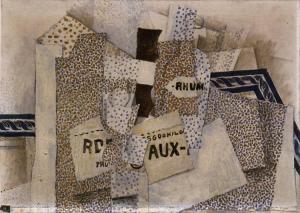
Braque invented in 1912. Braque, notwithstanding, took collage 1-step further by gluing cutting-upward advertisements into his canvases. This foreshadowed modernistic fine art movements concerned with critiquing media, such asPop art.
Braque stenciled letters onto paintings, blended pigments with sand, and copied wood grain and marble to attain great levels of dimension in his paintings. His depictions of still lifes are then abstract that they border on becoming patterns that limited an essence of the objects viewed rather than directly representations.

Childhood
Georges Braque was guided from a young age toward creative painting techniques. His male parent managed a decorative painting concern and Braque'south interest in texture and tactility possibly came from working with him as a decorator. In 1899, at age seventeen, Braque moved from Argenteuil into Paris, accompanied by friends Othon Friesz and Raoul Dufy.
Early Training
Braque'south earliest paintings were made in the Fauvist style. From 1902-1905, after giving up piece of work every bit a decorator to pursue painting full-time he pursued Fauvist ideas and coordinated withHenri Matisse. He contributed his Fauvist colorful paintings to his starting time exhibition at theSalon des Independants in 1906. However, he was extremely afflicted by a visit to Pablo Picasso'due south studio in 1907, to run into Picasso's quantum work –Les Demoiselles d'Avignon.
Afterward this encounter, the 2 artists forged an intimate friendship and artistic camaraderie. "We would get

together every single mean solar day," Braque said, "to discuss and analysis the ideas that were forming, likewise every bit to compare our respective works". The drastic modify in Braque's painting manner can be direct attributed to Picasso. Once he understood Picasso's goals, Braque aimed to strengthen "the constructive elements in his works while foregoing the expressive excesses of Fauvism". His landscape paintings in which scenes were distilled into basic shapes and colors inspired French fine art critic, Louis Vauxcelles, to coin the term Cubism by describing Braque'south piece of work as "bizarreries cubiques."
Braque and Picasso worked in synchronicity until Braque's return from war in 1914. When Picasso began to paint figuratively, Braque felt his friend had betrayed their Cubist systems and rules, and continued on his own. Still, he continued to remain influenced by Picasso'south piece of work, especially in regards to papier colles, a collage technique pioneered by both artists using only pasted newspaper. His collages featured geometric shapes interrupted past musical instruments, grapes, or article of furniture. These were and so three-dimensional that they are considered of import in the development of Cubist sculpture. By 1918, Braque felt he had sufficiently exploredpapier colles, and returned to still life painting.

Viewers noted a more than limited palette at Braque's start post-war solo show in 1919. Yet he steadfastly adhered to Cubist rules about depicting objects from multi-faceted perspectives in geometrically patterned ways. In this, he continued equally a trueAnalytical Cubist longer than did Picasso, whose style, subject area matter and palettes inverse continuously. Braque was virtually interested in showing how objects expect when viewed over time in unlike temporal spaces and pictorial planes. Equally a issue of his dedication to depicting space in various ways, he naturally gravitated towards designing sets and costumes for theater and ballet performances, doing this throughout the 1920s.
In 1929, Braque took upwards mural painting one time over again, using new, bright colors influenced past Picasso and Matisse. Then in the 1930s, Braque began to portray Greek heroes and deities, though he claimed the subjects were stripped of their symbolism and ought to be viewed through a purely formal lens.
He chosen these works exercises in calligraphy, possibly because they were not strictly about figures but more nigh sheer line and shape. In the latter half of the 1930s, Braque embarked on painting hisVanitas serial, through which he existentially considered death and suffering. Growing increasingly obsessed with the

physicality of his paintings, he explored the means in which brushstrokes and pigment qualities could enhance his subject matter.
The objects used in his still lifes were highly personal to Braque, however, he did not reveal these meanings. Skulls, for example, were objects he painted repeatedly at the onset of Globe State of war II. In 1944, when World War Ii concluded, Braque began to embrace lighter subjects like flowers, billiard tables, and garden chairs.
His final series of eight canvases made from 1948-1955, each titledAtelier, or Studio, depicted imagery that represented the creative person'south inner thoughts on each object rather than clues to the outside earth. At the very finish of his life, Braque painted birds repeatedly, as the perfect symbol of his obsession with space and movement.

Braque is remembered every bit a progenitor of Cubism, who was both rational and sensuous in his still life paintings. He was a archetype painter in this sense, and has influenced the likes ofJim Dine andWayne Thiebaud, who focused on still life painting. Braque is also a historic colorist, and can be traced through contemporary art to those painters who work with color in similar ways. Perhaps Braque is most remembered for his use of collage, every bit many contemporary artists, from sculptors similar Jessica Stockholder to painters like Marking Bradford, employ paper to their works as a means to comment on order and its products.
"To piece of work from nature is to improvise."
"One must not imitate what one wants to create."
"1 must beware of an all-purpose formula that will serve to translate the other arts equally well equally reality, and that instead of creating volition but produce a style, or rather a stylization."
Biography is from www.artstory.org.
I hope yous relish my piece today! It was a very educational experience and interesting as well! I wish I had more than time to work on information technology. It's not perfect, but I recollect I did well. I will encounter you tomorrow on Day 333.
Best,
Linda

Linda Cleary 2014
Acrylic and Ink on Canvas

Woman at a Piano- Tribute to Georges Braque
Linda Cleary 2014
Acrylic and Ink on Canvas

Woman at a Piano- Tribute to Georges Braque
Linda Cleary 2014
Acrylic and Ink on Canvas

Woman at a Piano- Tribute to Georges Braque
Linda Cleary 2014
Acrylic and Ink on Canvas

Woman at a Pianoforte- Tribute to Georges Braque
Linda Cleary 2014
Acrylic and Ink on Canvas

carrollfortionle64.blogspot.com
Source: https://dayoftheartist.com/2014/11/28/day-332-georges-braque-temporal-spaces/
0 Response to "Braque Felt That Emotion Is ââåtranslated and Transmutedã¢ââ Into Art"
Enregistrer un commentaire