The Tulip Bubble the First Big Bust Documentry Review
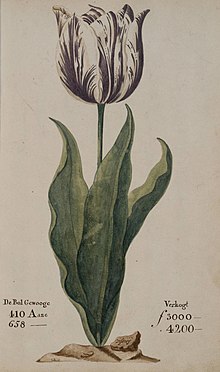
A tulip, known as "the Viceroy" (viseroij), displayed in the 1637 Dutch catalogue Verzameling van een Meenigte Tulipaanen. Its bulb was offered for sale for betwixt 3,000 and 4,200 guilders (florins) depending on weight (gewooge). A skilled craftsworker at the fourth dimension earned most 300 guilders a year.[ane]
Tulip mania (Dutch: tulpenmanie) was a menses during the Dutch Golden Age when contract prices for some bulbs of the recently introduced and fashionable tulip reached extraordinarily loftier levels, with the major acceleration starting in 1634 and then dramatically collapsing in February 1637.[2] It is by and large considered to have been the first recorded speculative bubble or asset bubble in history.[3] In many ways, the tulip mania was more of a so-unknown socio-economical phenomenon than a significant economic crunch. It had no disquisitional influence on the prosperity of the Dutch Republic, which was one of the world's leading economic and financial powers in the 17th century, with the highest per capita income in the world from about 1600 to nearly 1720.[4] [v] [6] The term "tulip mania" is now often used metaphorically to refer to whatsoever large economic bubble when nugget prices deviate from intrinsic values.[7] [8]
Formal futures markets appeared in the Dutch Democracy during the 17th century. Among the well-nigh notable centred on the tulip marketplace, at the height of tulip mania.[9] [10] At the meridian of tulip mania, in February 1637, some single tulip bulbs sold for more than 10 times the annual income of a skilled artisan. Inquiry is difficult because of the express economic data from the 1630s, much of which come from biased and speculative sources.[xi] [12] Some modern economists take proposed rational explanations, rather than a speculative mania, for the rise and autumn in prices. For example, other flowers, such equally the hyacinth, also had high initial prices at the time of their introduction, which then barbarous as the plants were propagated. The high nugget prices may also have been driven by expectations of a parliamentary decree that contracts could exist voided for a small cost, thus lowering the risk to buyers.
The 1637 result gained popular attending in 1841 with the publication of the volume Extraordinary Pop Delusions and the Madness of Crowds, written by Scottish journalist Charles Mackay, who wrote that at i point v hectares (12 acres) of state were offered for a Semper Augustus bulb.[13] Mackay claimed that many investors were ruined by the fall in prices, and Dutch commerce suffered a severe shock. Although Mackay's book is a archetype, his account is contested. Many modern scholars believe that the mania was not as subversive as he described, merely was limited to cliques of urban artisans.[xiv] [15] [16] [17]
Background and history [edit]

A Satire of Tulip Mania past Jan Brueghel the Younger (ca. 1640) depicts speculators as brainless monkeys in contemporary upper-grade dress. In a commentary on the economical folly, ane monkey urinates on the previously valuable plants, others announced in debtor'southward courtroom and one is carried to the grave.
The Dutch tulip business [edit]
From about the early 1600s to about the mid-18th century, the Dutch Republic's economic, business organisation and financial systems were the most advanced and sophisticated always seen in history.[18] [19] [20] [21] [22] [23] In its Golden Age, the Dutch Democracy was responsible for many pioneering innovations in economic, business and fiscal history of the earth,[24] like the showtime well-recorded asset price bubble in history (in the 1630s), early stock market bubbles and crashes had their roots in socio-politico-economic activities of the 17th-century Dutch Republic (the birthplace of the world's first formal stock exchange and stock market),[25] [21] [26] [27] the Dutch Eastward India Visitor (the earth's kickoff formally listed public company) and the Dutch W India Company, in particular.
The introduction of the tulip to Europe is often questionably attributed to Ogier de Busbecq, the ambassador of Ferdinand I, Holy Roman Emperor, to the Sultan of Turkey, who sent the first tulip bulbs and seeds to Vienna in 1554 from the Ottoman Empire.[28] [29] Tulip bulbs, along with other new plant life similar potatoes, peppers, tomatoes and other vegetables, came to Europe in the 16th century.[30] These bulbs were soon distributed from Vienna to Augsburg, Antwerp and Amsterdam.[31] Their popularity and cultivation in the United Provinces (now the Netherlands)[32] is more often than not thought to take started in hostage around 1593 subsequently the Southern Netherlandish botanist Carolus Clusius had taken up a post at the Academy of Leiden and established the hortus academicus.[33] He planted his collection of tulip bulbs and found that they were able to tolerate the harsher atmospheric condition of the Low Countries;[34] shortly thereafter, the tulip began to grow in popularity.[35]
The tulip was dissimilar from other flowers known to Europe at that time, considering of its intense saturated petal colour. The appearance of the nonpareil tulip every bit a status symbol coincides with the rising of newly independent Holland'due south trade fortunes. No longer the Castilian Netherlands, its economic resources could now be channelled into commerce and the country embarked on its Golden Historic period. Amsterdam merchants were at the centre of the lucrative East Indies trade, where one voyage could yield profits of 400%.[36]

Anonymous 17th-century watercolour of the Semper Augustus, famous for existence the about expensive tulip sold during the tulip mania.
As a result, tulips quickly became a coveted luxury item, and a profusion of varieties followed. They were classified in groups: the single-hued tulips of ruddy, xanthous, or white were known every bit Couleren; the multicolored Rosen (white streaks on a reddish or pink background); Violetten (white streaks on a regal or lilac background); and the rarest of all, the Bizarden (Bizarres), (yellow or white streaks on a scarlet, brown or majestic background).[37] The multicolour effects of intricate lines and flame-like streaks on the petals were vivid and spectacular, making the bulbs that produced these even more exotic-looking plants highly sought-afterward. Information technology is now known that this effect is due to the bulbs beingness infected with a type of tulip-specific mosaic virus, known equally the "tulip breaking virus", so called because it "breaks" the ane petal colour into two or more.[38] [39]
Growers named their new varieties with exalted titles. Many early forms were prefixed Admirael ("admiral"), frequently combined with the growers' names: Admirael van der Eijck, for instance, was perhaps the virtually highly regarded of about fifty so named. Generael ("full general") was some other prefix used for around xxx varieties. Later varieties were given even more improvident names, derived from Alexander the Not bad or Scipio, or even "Admiral of Admirals" and "General of Generals". Naming could be haphazard and varieties highly variable in quality.[40] Nigh of these varieties have now died out.[41]
Tulips abound from bulbs and tin exist propagated through both seeds and buds. Seeds from a tulip will form a flowering bulb after seven–12 years. When a bulb grows into the flower, the original bulb volition disappear, merely a clone bulb forms in its place, as do several buds. Properly cultivated, these buds volition go flowering bulbs of their ain, commonly later a couple of years. The tulip breaking virus spreads but through buds, not seeds, and propagation is greatly slowed downwards by the virus. Cultivating the varieties that were most appealing at the time therefore takes years. In the Northern Hemisphere, tulips bloom in April and May for about 1 week. During the establish'due south dormant stage from June to September, bulbs tin be uprooted and moved most, so actual purchases (in the spot market) occurred during these months.[42] During the rest of the year, florists, or tulip traders, signed contracts before a notary to buy tulips at the end of the season (effectively futures contracts).[42] Thus the Dutch, who adult many of the techniques of modern finance, created a marketplace for tulip bulbs, which were durable appurtenances.[32] Brusque selling was banned past an edict of 1610, which was reiterated or strengthened in 1621 and 1630, and once again in 1636. Brusk sellers were not prosecuted under these edicts, merely futures contracts were deemed unenforceable, so traders could repudiate deals if faced with a loss.[43]
Speculative menses [edit]

Wagon of Fools by Hendrik Gerritsz Pot, 1637. Followed by Haarlem weavers who have abased their looms, diddled past the air current and flight a flag emblazoned with tulips, Flora, goddess of flowers, her arms laden with tulips, rides to their destruction in the sea forth with tipplers, coin changers and the two-faced goddess Fortuna.

A standardized toll index for tulip bulb contracts, created by Earl Thompson. Thompson had no price data between February 9 and May 1, thus the shape of the decline is unknown. The tulip market is known to have collapsed abruptly in February.[44]
As the flowers grew in popularity, professional growers paid higher and higher prices for bulbs with the virus, and prices rose steadily. By 1634, in role as a result of demand from the French, speculators began to enter the market.[45] The contract price of rare bulbs continued to rise throughout 1636, only past November, the price of common, "unbroken" bulbs as well began to increment, then that soon any tulip bulb could fetch hundreds of guilders. That year the Dutch created a blazon of formal futures marketplace where contracts to buy bulbs at the end of the season were bought and sold. Traders met in "colleges" at taverns and buyers were required to pay a ii.5% "wine money" fee, upward to a maximum of 3 guilders per trade. Neither party paid an initial margin, nor a marking-to-market margin, and all contracts were with the private counter-parties rather than with the Exchange. The Dutch described tulip contract trading as windhandel (literally "wind trade"), considering no bulbs were really changing hands. The entire business was achieved on the margins of Dutch economic life, not in the Substitution itself.[46]
Past 1636, the tulip bulb became the fourth leading export product of the netherlands, later on gin, herrings, and cheese. The cost of tulips skyrocketed considering of speculation in tulip futures amid people who never saw the bulbs. Many men made and lost fortunes overnight.[47]

The Tulip Folly, past Jean-Léon Gérôme, 1882. A nobleman guards an exceptional bloom as soldiers bruise flowerbeds in a vain attempt to stabilise the tulip market place past limiting the supply.
Tulip mania reached its peak during the winter of 1636–37, when some bulb contracts were reportedly changing hands ten times in a twenty-four hours. No deliveries were always made to fulfill any of these contracts, considering in February 1637, tulip bulb contract prices collapsed abruptly and the trade of tulips ground to a halt.[48] The plummet began in Haarlem, when, for the first time, buyers manifestly refused to show up at a routine seedling auction. This may have been because Haarlem was so suffering from an outbreak of bubonic plague. The existence of the plague may take helped to create a culture of fatalistic gamble-taking that immune the speculation to skyrocket in the get-go place;[49] this outbreak might too have helped to burst the bubble.[l]
After the market complanate, the problem of resolving hundreds of disputed sales remained. The matter was brought to the Court of Holland, which ordered each city to freeze tulip agreements, investigate the matter, and then act according to its own judgment. The process took the longest in Haarlem, where the metropolis airtight the courts to tulip cases and left parties to resolve their own disputes through arbitration or otherwise. Although a minority of determined growers pressed for full payment, it was less trouble to settle on terms that buyers could actually pay.[51]
Available price information [edit]
The lack of consistently recorded cost data from the 1630s makes the extent of the tulip mania difficult to discern. The bulk of available data comes from an anonymous satire, Dialogues between Waermondt and Gaergoedt, written just afterward the bubble. Economist Peter Garber collected data on the sales of 161 bulbs of 39 varieties between 1633 and 1637, with 53 being recorded in the Dialogues . Ninety-8 sales were recorded for the last date of the chimera, February five, 1637, at wildly varying prices. The sales were fabricated using several market mechanisms: futures trading at the colleges, spot sales past growers, notarized futures sales by growers, and estate sales. "To a great extent, the available price data are a alloy of apples and oranges", co-ordinate to Garber.[52]
Mackay's Madness of Crowds [edit]
| Basket of appurtenances allegedly exchanged for a unmarried seedling of the Viceroy [53] | |
|---|---|
| Two lasts of wheat | 448ƒ |
| Four lasts of rye | 558ƒ |
| Four fat oxen | 480ƒ |
| Eight fat swine | 240ƒ |
| Twelve fat sheep | 120ƒ |
| Two hogsheads of vino | 70ƒ |
| Iv tuns of beer | 32ƒ |
| Two tuns of butter | 192ƒ |
| i,000 lbs. of cheese | 120ƒ |
| A consummate bed | 100ƒ |
| A suit of dress | 80ƒ |
| A silverish drinking cup | 60ƒ |
| Total | 2500ƒ |
The mod discussion of tulip mania began with the book Extraordinary Popular Delusions and the Madness of Crowds, published in 1841 past the Scottish journalist Charles Mackay; he proposed that crowds of people often behave irrationally, and tulip mania was, along with the Due south Sea Bubble and the Mississippi Company scheme, one of his chief examples. His business relationship was largely sourced from a 1797 work by Johann Beckmann titled A History of Inventions, Discoveries, and Origins.[xiv] Beckmann in plough used several available sources, but all of them drew heavily from the satirical Dialogues that were written to mock the speculators.[54] Mackay's vivid book was popular amid generations of economists and stock market participants. His popular but flawed description of tulip mania as a speculative bubble remains prominent, even though since the 1980s economists accept debunked many aspects of his account.[54]
According to Mackay, the growing popularity of tulips in the early 17th century caught the attending of the unabridged nation; "the population, fifty-fifty to its lowest dregs, embarked in the tulip trade".[thirteen] By 1635, a sale of xl bulbs for 100,000 florins (too known as Dutch guilders) was recorded. By way of comparison, a "tun" (930 kg or 2,050 lb) of butter cost around 100 florins, a skilled laborer might earn 150–350 florins a twelvemonth, and "eight fat swine" cost 240 florins.[13]
By 1636, tulips were traded on the exchanges of numerous Dutch towns and cities. This encouraged trade past all members of society; Mackay recounted people selling possessions in order to speculate on the tulip market, such as an offer of 5 hectares (12 acres) of state for one of two existing Semper Augustus bulbs, or a unmarried seedling of the Viceroy that, he said, was purchased in exchange for a handbasket of goods (shown in table) worth 2,500 florins.[53]
Many individuals suddenly became rich. A gilt bait hung temptingly out earlier the people, and, one later on the other, they rushed to the tulip marts, like flies effectually a honey-pot. Every 1 imagined that the passion for tulips would last for ever, and that the wealthy from every role of the earth would transport to Holland, and pay whatever prices were asked for them. The riches of Europe would be concentrated on the shores of the Zuyder Zee, and poverty banished from the favoured clime of Kingdom of the netherlands. Nobles, citizens, farmers, mechanics, seamen, footmen, maidservants, fifty-fifty chimney sweeps and sometime clotheswomen, dabbled in tulips.[xiii]

Pamphlet from the Dutch tulipomania, printed in 1637
The increasing mania generated several amusing, if unlikely, anecdotes that Mackay recounted, such as a sailor who mistook the valuable tulip seedling of a merchant for an onion and grabbed it to eat. Co-ordinate to Mackay, the merchant and his family unit hunted downwardly the sailor to discover him "eating a breakfast whose cost might have regaled a whole ship's coiffure for a yr"; the sailor was supposedly jailed for eating the bulb.[13] Withal, tulips are poisonous if prepared incorrectly, taste bad, and are considered to be only marginally edible even during famines.[55] This direct contradicts Mackay's claim that the tulip seedling had been "quite delicious".[13]
People were purchasing bulbs at college and higher prices, intending to re-sell them for a profit. Such a scheme could not final unless someone was ultimately willing to pay such high prices and take possession of the bulbs. In February 1637, tulip traders could no longer find new buyers willing to pay increasingly inflated prices for their bulbs. Equally this realization prepare in, the demand for tulips collapsed, and prices plummeted—the speculative bubble burst. Some were left holding contracts to buy tulips at prices at present x times greater than those on the open marketplace, while others found themselves in possession of bulbs at present worth a fraction of the price they had paid. Mackay says the Dutch devolved into distressed accusations and recriminations confronting others in the merchandise.[13]
In Mackay'due south account, the panicked tulip speculators sought aid from the government of the Netherlands, which responded past declaring that anyone who had bought contracts to purchase bulbs in the future could void their contract by payment of a x percentage fee. Attempts were made to resolve the situation to the satisfaction of all parties, simply these were unsuccessful. The mania finally ended, Mackay says, with individuals stuck with the bulbs they held at the end of the crash—no court would enforce payment of a contract, since judges regarded the debts as contracted through gambling, and thus non enforceable past law.[13]
According to Mackay, lesser tulip manias also occurred in other parts of Europe, although matters never reached the state they had in the Netherlands. He also idea that the aftermath of the tulip price deflation led to a widespread economic chill throughout the Netherlands for many years afterward.[xiii]
Modern views [edit]
Mackay's business relationship of inexplicable mania was unchallenged, and mostly unexamined, until the 1980s.[56] Inquiry into tulip mania since then, especially by proponents of the efficient-marketplace hypothesis,[17] suggests that his story was incomplete and inaccurate. In her 2007 scholarly analysis Tulipmania, Anne Goldgar states that the phenomenon was limited to "a fairly small group", and that most accounts from the catamenia "are based on one or 2 gimmicky pieces of propaganda and a prodigious amount of plagiarism".[eleven] Peter Garber argues that the merchandise in common bulbs "was no more than than a meaningless wintertime drinking game, played by a plague-ridden population that fabricated employ of the vibrant tulip market."[57]
While Mackay's account held that a broad assortment of society was involved in the tulip merchandise, Goldgar'due south report of archived contracts plant that even at its peak the trade in tulips was conducted near exclusively past merchants and skilled craftsmen who were wealthy, only not members of the dignity.[58] Any economic fallout from the bubble was very limited. Goldgar, who identified many prominent buyers and sellers in the market, found fewer than half a dozen who experienced financial troubles in the time period, and even of these cases it is non articulate that tulips were to blame.[59] This is non birthday surprising. Although prices had risen, money had not changed easily between buyers and sellers. Thus profits were never realised for sellers; unless sellers had made other purchases on credit in expectation of the profits, the collapse in prices did non cause anyone to lose money.[60]

Even so Life with Flowers (1639), by Hans Bollongier (1623–1672), showcases the prized Semper Augustus tulip.
Rational explanations [edit]
It is well established that prices for tulip seedling contracts rose so vicious between 1636 and 1637; withal, such dramatic curves do not necessarily imply that an economic or speculative bubble adult and then burst. For the then tulip market place to qualify as an economic chimera, the price of bulbs would demand to have been mutually agreed and surpassed the intrinsic value of the bulbs. Mod economists have advanced several possible reasons for why the rise and fall in prices may not take constituted a bubble, fifty-fifty though a Viceroy Tulip was worth upwards of five times the price of an average firm at the time.[61]
The increases of the 1630s corresponded with a lull in the 30 Years' War.[62] In 1634–1635 the High german and Swedish armies lost ground in the S of Germany; and then Cardinal-Infante Ferdinand of Austria moved northward. After the Peace of Prague the French and the Dutch decided to back up the Swedish and High german Protestants with money and arms against the Habsburg empire, and to occupy the Spanish Netherlands in 1636. Hence market prices, at least initially, were responding rationally to a rise in demand. The autumn in prices was faster and more dramatic than the rise. Data on sales largely disappeared after the Feb 1637 collapse in prices, but a few other information points on seedling prices after tulip mania bear witness that bulbs connected to lose value for decades thereafter.[ citation needed ]
Natural volatility in flower prices [edit]
Garber compared the available price data on tulips to hyacinth prices at the starting time of the 19th century when the hyacinth replaced the tulip as the fashionable blossom and found a similar pattern. When hyacinths were introduced florists strove with one another to abound beautiful hyacinth flowers, as demand was stiff. As people became more accustomed to hyacinths the prices began to fall. The most expensive bulbs roughshod to 1 to 2 percent of their acme value within 30 years.[63] Garber besides notes that, "a small quantity of prototype lily bulbs recently was sold for 1 one thousand thousand guilders ($US480,000 at 1987 exchange rates)", demonstrating that even in the modern world, flowers can control extremely high prices.[64] Considering the rise in prices occurred after bulbs were planted for the year, growers would non take had an opportunity to increase production in response to price.[65]
Critiques [edit]
Other economists believe that these elements cannot completely explain the dramatic ascent and fall in tulip prices.[66] Garber's theory has also been challenged for failing to explicate a similar dramatic rise and fall in prices for regular tulip seedling contracts.[vii] Some economists too point to other factors associated with speculative bubbles, such as a growth in the supply of money, demonstrated by an increase in deposits at the Bank of Amsterdam during that period.[67]
Legal changes [edit]

Admirael van der Eijck from the 1637 catalog of P.Cos., sold for 1045 guilders on February 5, 1637
Earl Thompson argued in a 2007 paper that Garber's caption cannot account for the extremely swift driblet in tulip bulb contract prices. The annualised rate of price decline was 99.999%, instead of the average 40% for other flowers.[61] He provided another explanation for Dutch tulip mania. Since belatedly 1636, the Dutch parliament had been because a decree (originally sponsored past Dutch tulip investors who had lost money because of a High german setback in the Thirty Years' War[68]) that changed the way tulip contracts functioned:
On February 24, 1637, the cocky-regulating guild of Dutch florists, in a conclusion that was afterwards ratified by the Dutch Parliament, announced that all futures contracts written subsequently November 30, 1636, and before the re-opening of the cash marketplace in the early Leap, were to be interpreted as choice contracts. They did this by simply relieving the futures buyers of the obligation to buy the future tulips, forcing them merely to recoup the sellers with a small stock-still percent of the contract price.[69]
Earlier this parliamentary decree, the purchaser of a tulip contract—known in mod finance equally a forward contract—was legally obliged to buy the bulbs. The decree inverse the nature of these contracts, so that if the current marketplace price fell, the purchaser could opt to pay a penalisation and forgo receipt of the seedling, rather than pay the full contracted price. This change in law meant that, in modern terminology, the futures contracts had been transformed into options contracts—contracts which were extremely favourable to the buyers.
Thompson argues that the "bubble" in the price of tulip bulb futures prior to the February 1637 prescript was due primarily to buyers' awareness of what was coming. Although the final 3.5% strike price was not actually settled until Feb 24, Thompson writes, "equally data ... entered the market in late November, contract prices soared to reflect the expectation that the contract toll was now a phone call-option exercise, or strike, price rather than a price committed to be paid."[69] Thompson concludes that "the real victims of the contractual conversion" were the investors who had bought futures contracts prior to November xxx, 1636, on the incorrect assumption that their contracts would benefit from the Feb 1637 decree.[69] In other words, many investors were making an "additional take chances with respect to the prices the buyers would eventually have to pay for their options"[70]—a factor unrelated to the intrinsic value of the tulip bulbs themselves.
Using information near the specific payoffs nowadays in the futures and options contracts, Thompson argued that tulip bulb contract prices hewed closely to what a rational economical model would dictate: "Tulip contract prices before, during, and after the 'tulipmania' appear to provide a remarkable illustration of efficient market prices."[seventy]
Social mania and legacy [edit]

A modern-twenty-four hour period field of tulips in holland; the flower remains a popular symbol of the Netherlands.
The popularity of Mackay's tale has continued to this twenty-four hours, with new editions of Boggling Popular Delusions appearing regularly, with introductions by writers such equally financier Bernard Baruch (1932), financial writer Andrew Tobias (1980),[71] psychologist David J. Schneider (1993), and journalist Michael Lewis (2008).
Goldgar argues that although tulip mania may not have constituted an economic or speculative bubble, it was still traumatic to the Dutch for other reasons: "Even though the fiscal crisis affected very few, the shock of tulipmania was considerable. A whole network of values was thrown into doubt."[72] In the 17th century, it was unimaginable to well-nigh people that something equally mutual every bit a flower could be worth so much more than money than most people earned in a yr. The idea that the prices of flowers that abound only in the summer could fluctuate then wildly in the winter, threw into chaos the very understanding of "value".[73]
Many of the sources telling of the woes of tulip mania, such as the anti-speculative pamphlets that were afterwards reported by Beckmann and Mackay, have been cited as evidence of the extent of the economic damage. These pamphlets were not written by victims of a bubble, but were primarily religiously motivated. The upheaval was viewed as a perversion of the moral order—proof that "concentration on the earthly, rather than the heavenly flower could have dire consequences".[74]
Almost a century afterward, during the crash of the Mississippi Company and the South Sea Company in well-nigh 1720, tulip mania appeared in satires of these manias.[75] When Johann Beckmann first described tulip mania in the 1780s, he compared information technology to the failing lotteries of the time.[76] In Goldgar'south view, even many modern popular works almost financial markets, such as Burton Malkiel's A Random Walk Downward Wall Street (1973) and John Kenneth Galbraith'southward A Short History of Fiscal Euphoria (1990; written soon after the crash of 1987), used the tulip mania equally a lesson in morality.[77] [78] [79] Tulip mania over again became a popular reference during the dot-com bubble of 1995–2001.[77] [lxxx] and the subprime mortgage crisis of 2007–2010.[81] [82] In 2013, Nout Wellink, onetime president of the Dutch Central Bank, described Bitcoin every bit "worse than the tulip mania", adding, "At to the lowest degree then you lot got a tulip, at present yous become naught."[83] Despite the mania's enduring popularity, Daniel Gross has said of economists offering efficient-market explanations for the mania, "If they're correct ... so business writers volition have to delete Tulipmania from their handy-pack of bubble analogies."[84]
Notes [edit]
- ^ Nusteling, H. (1985) Welvaart en Werkgelegenheid in Amsterdam 1540–1860, pp. 114, 252, 254, 258.
- ^ Dash 2001, p.[ page needed ].
- ^ Shiller 2005, p. 85 More extensive discussion of status as the primeval bubble on pp. 247–48.
- ^ In Karl Marx's ain words, "Its [17th-century Dutch Democracy's] fisheries, marine, articles, surpassed those of any other country. The total capital of the Republic was probably more of import than that of all the residuum of Europe put together." (Das Kapital)
- ^ Kaletsky, Anatole: Capitalism iv.0: The Nascence of a New Economic system in the Aftermath of Crisis. (PublicAffairs, 2010), pp. 109–ten. Anatole Kaletsky: "The bursting of the tulip bubble in 1637 did non end Dutch economic hegemony. Far from it. Tulipmania was followed by a century of Dutch leadership in virtually every branch of global commerce, finance, and manufacturing."
- ^ Gieseking, Jen Jack; Mangold, William; et al.: The People, Place, and Space Reader. (Routledge, 2014, ISBN 978-0415664974), p. 151. As Witold Rybczynski (1987) notes, the 17th-century Dutch Democracy "had few natural resource—no mines, no forests—and what little land there was needed constant protection from the bounding main. But this "low" land surprisingly chop-chop established itself as a major power. In a short time it became the most advanced shipbuilding nation in the world and developed large naval, fishing, and merchant fleets. (...) Holland introduced many fiscal innovations that made information technology a major economic strength—and Amsterdam became the world centre for international finance. Its manufacturing towns grew so quickly that past the heart of the century the netherlands had supplanted France every bit the leading industrial nation of the world."
- ^ a b French 2006, p. iii
- ^ Fowler, Mark; Felton, Bruce (Baronial one, 2004). The Best, Worst, & Nigh Unusual: Noteworthy Achievements, Events, Feats & Blunders of Every Conceivable Kind. Galahad. ISBN978-0883658611.
- ^ Chew, Donald H.: Corporate Take a chance Management. (Columbia Academy Press, 2008, ISBN 0231143621)
- ^ Pavaskar, Madhoo: Article Derivatives Trading: Theory and Regulation. (Notion Printing, 2016, ISBN 1945926228)
- ^ a b Kuper, Simon (May 12, 2007). "Petal Power". Financial Times. Archived from the original on May 7, 2015. Retrieved July 1, 2008. (Review of Goldgar 2007)
- ^ A pamphlet nigh the Dutch tulipomania Archived May 27, 2012, at archive.today Wageningen Digital Library, July 14, 2006. Retrieved on August 13, 2008.
- ^ a b c d e f one thousand h i "The Tulipomania", Chapter 3, in Mackay 1841.
- ^ a b Goldgar 2008, pp. v, 6.
- ^ Goldgar, Anne (Feb 12, 2018), "Tulip mania: the classic story of a Dutch financial bubble is mostly incorrect", The Conversation, Boston, MA, archived from the original on February 7, 2021, retrieved February 13, 2018
- ^ Thompson 2007, p. 99
- ^ a b Kindleberger & Aliber 2005, p. 115
- ^ Wallerstein, Immanuel (2011). The Mod World-System II: Mercantilism and the Consolidation of the European Globe-Economy, 1600–1750. (Academic Press, 1980), p. 43-44. Immanuel Wallerstein (1980): "(...) The second great industry of early mod times was shipbuilding, and hither as well the lead of the United Provinces is mutual cognition. Less widely acknowledged but essential to a clear analysis is the fact that the Dutch shipbuilding manufacture was "of modern dimensions, inclining strongly toward standardised, repetitive methods." It was highly mechanised and used many labour-saving devices – wind-powered sawmills, powered feeders for saw, cake and tackles, neat cranes to motion heavy timbers – all of which increased productivity."
- ^ Moore, Jason W. (December 20, 2017). "World aggregating & Planetary life, or, why capitalism volition not survive until the 'last tree is cutting'". Political Economy Research Center, Goldsmiths, Academy of London (perc.org.united kingdom). Retrieved November 1, 2018.
Jason W. Moore (2017): "(...) If one looks closely at the Dutch in the seventeenth century nosotros tin can see almost every major feature of large-scale manufacture credited to the English two centuries subsequently. Production was increasingly mechanised, equally in sawmilling; standardised parts were deployed in manufacturing, especially in shipbuilding; modern financial markets were developed, underscored past the formation of the Amsterdam Bourse in 1602. And it was all underwritten by an agricultural organisation that did what all capitalist agricultures must do: produce more and more food with less and less labour-time."
- ^ "The Keynes Conundrum by David P. Goldman". First Things (firstthings.com). Oct ane, 2010. Retrieved November 11, 2017.
Reuven Brenner & David P. Goldman (2010): "Western societies developed the institutions that support entrepreneurship only through a long and fitful procedure of trial and error. Stock and commodity exchanges, investment banks, mutual funds, deposit cyberbanking, securitisation, and other markets have their roots in the Dutch innovations of the seventeenth century but reached maturity, in many cases, but during the past quarter of a century."
- ^ a b Goetzmann, William N.; Rouwenhorst, K. Geert (2005). The Origins of Value: The Financial Innovations that Created Modern Majuscule Markets. Oxford University Press. pp. 165–175. ISBN9780195175714. Archived from the original on August xix, 2020. Retrieved February 2, 2021.
- ^ Goetzmann, William N.; Rouwenhorst, Grand. Geert (2008). The History of Financial Innovation, in Carbon Finance, Environmental Market Solutions to Climate change. (Yale School of Forestry and Environmental Studies, chapter 1, pp. 18–43). Goetzmann & Rouwenhorst (2008): "The 17th and 18th centuries in the Netherlands were a remarkable time for finance. Many of the financial products or instruments that nosotros see today emerged during a relatively short catamenia. In particular, merchants and bankers developed what we would today call securitisation. Common funds and various other forms of structured finance that withal exist today emerged in the 17th and 18th centuries in Kingdom of the netherlands."
- ^ Soll, Jacob (2014). The Reckoning: Financial Accountability and the Making and Breaking of Nations. New York: Bones Books.
Jacob Soll (2014): "With the complication of the stock exchange, [17th-century] Dutch merchants' knowledge of finance became more sophisticated than that of their Italian predecessors or German neighbours."
- ^ Johannessen, Jon-Arild: Innovations Pb to Economic Crises: Explaining the Bubble Economy. (London: Palgrave Macmillan, 2017)
- ^ Brooks, John (1968). Concern Adventures: Twelve Classic Tales from the Globe of Wall Street. Weybright & Talley. ISBN9781497638853. Archived from the original on July fourteen, 2014. Retrieved February 2, 2021.
- ^ Petram, Lodewijk (2014). The World'due south First Stock Exchange: How the Amsterdam Marketplace for Dutch East India Visitor Shares Became a Modern Securities Market, 1602–1700. Translated by Richards, Lynne. Columbia University Press. ISBN9780231537322. Archived from the original on September 19, 2020. Retrieved February 2, 2021.
- ^ Macaulay, Catherine R. (2015). "Capitalism's renaissance? The potential of repositioning the financial 'meta-economy'". (Futures, Volume 68, April 2015, p. v–18)
- ^ Pavord 2014, p. 4, Introduction.
- ^ Panic, Prosperity, and Progress- Timothy Knight, p.i
- ^ Harford, Tim (March iv, 2020). "Are nosotros wrong about what happened with Tulip Mania?". BBC News. Archived from the original on March 4, 2020. Retrieved March 4, 2020.
- ^ Burden, Alan; Walsh, John, "'Broken' tulips and Tulip breaking virus", Microbiology Today, May 2005, p. 68.
- ^ a b Garber 1989, p. 537
- ^ Nuance 1999, pp. 59–threescore
- ^ Goldgar 2007, p. 32.
- ^ Goldgar 2007, p. 33.
- ^ Ricklefs, G. C. (1991). A History of Modern Indonesia Since c. 1300, 2nd Edition. London: MacMillan. p. 27
- ^ Dash 1999, p. 66
- ^ Phillips, Southward. "Tulip breaking potyvirus Archived Feb 20, 2009, at the Wayback Machine", in Brunt, A. A., Crabtree, K., Dallwitz, M. J., Gibbs, A. J., Watson, L. and Zurcher, E. J. (eds.) (1996 onwards). Constitute Viruses Online: Descriptions and Lists from the VIDE Database. Version: August 20, 1996. Retrieved on August 15, 2008.
- ^ Garber 1989, p. 542
- ^ Dash 1999, pp. 106–07
- ^ Garber 2000, p. 41
- ^ a b Garber 1989, pp. 541–42
- ^ Garber 2000, pp. 33–36
- ^ Thompson 2007, pp. 101, 109–eleven
- ^ Garber 1989, p. 543
- ^ Goldgar 2007, p. 322.
- ^ Schama 1997, pp. 350–366 esp p. 362.
- ^ Garber 1989, pp. 543–44
- ^ De Vries 1976, p. 226, quoted in Garber 2000, p. 38
- ^ Garber 2000, pp. 37–38, 44–47
- ^ Dash 1999, pp. 187–194
- ^ Garber 2000, pp. 49–59, 138–44
- ^ a b This basket of goods was really exchanged for a bulb co-ordinate to Chapter 3 of Mackay (1841) and besides Schama (1997), just Krelage (1942) and Garber (2000), pp. 81–83 dispute this interpretation of the original source, an anonymous pamphlet, saying that the commodity bundle was conspicuously given but to demonstrate the value of the florin at the time.
- ^ a b Garber 1990, p. 37
- ^ Deane, Green. "Tulips". Eat the Weeds. Archived from the original on December 25, 2013. Retrieved December 4, 2013.
- ^ Garber 1989, p. 535
- ^ Garber 2000, p. 81
- ^ Goldgar 2007, p. 141.
- ^ Goldgar 2007, pp. 247–48.
- ^ Goldgar 2007, p. 233.
- ^ a b Thompson 2007, p. 100
- ^ Thompson 2007, p. 103
- ^ Garber 1989, pp. 553–54
- ^ Garber 1989, p. 555
- ^ Garber 1989, pp. 555–56
- ^ Kindleberger & Aliber 2005, pp. 115–16
- ^ French 2006, pp. 11–12
- ^ Thompson 2007, pp. 103–04
- ^ a b c Thompson 2007, p. 101
- ^ a b Thompson 2007, p. 109
- ^ Introduction past Andrew Tobias to Boggling Popular Delusions and the Madness of Crowds (New York: Harmony Press, 1980) available at Andrew Tobias: Coin and Other Subjects Archived September eighteen, 2008, at the Wayback Machine. Retrieved on August 12, 2008
- ^ Goldgar 2007, p. 18.
- ^ Goldgar 2007, pp. 276–277.
- ^ Goldgar 2007, pp. 260–261.
- ^ Goldgar 2007, pp. 307–309.
- ^ Goldgar 2007, p. 313.
- ^ a b Goldgar 2007, p. 314.
- ^ Galbraith 1990, p. 34
- ^ Malkiel 2007, pp. 35–38
- ^ Frankel, Mark (Apr four, 2004). "When the Tulip Bubble Burst", Concern Calendar week.
- ^ "Bubble and Bust; Equally the subprime mortgage market tanks, policymakers must go on their nervus Archived May 14, 2011, at the Wayback Machine", The Washington Postal service, August 11, 2007. Retrieved on July 17, 2008.
- ^ Horton, Scott. "The Chimera Bursts", Harper's, Jan 27, 2008. Retrieved on July 17, 2008. Archived June 16, 2008, at the Wayback Machine
- ^ "Bitcoin hype worse than 'tulip mania', says Dutch central broker Archived March 20, 2017, at the Wayback Machine", The Guardian, December 4, 2013.
- ^ Gross, Daniel. "Bulb Bubble Problem; That Dutch tulip bubble wasn't then crazy after all Archived July 5, 2013, at the Wayback Machine", Slate, July 16, 2004. Retrieved on November iv, 2011.
References [edit]
- Cos, Pieter (1637), Verzameling van een meenigte tulipaanen, naar het leven geteekend met hunne naamen, en swaarte der bollen, zoo als dice publicq verkogt zijn, te Haarlem in den jaare A. 1637, door P. Cos, bloemist te Haarlem (in Dutch), Haarlem: [s.north.], 75 pl, archived from the original on April four, 2005, retrieved August 11, 2008
- Dash, Mike (1999), Tulipomania: The Story of the World'due south Virtually Coveted Flower and the Extraordinary Passions It Aroused, New York: Three Rivers Press, ISBN978-0-307-56082-7 , retrieved September 14, 2017
- Dash, Mike (2001), Tulipomania: The Story of the Earth's Most Coveted Bloom and the Boggling Passions It Angry
- De Vries, Jan (1976), The Economy of Europe in an Age of Crunch, 1600–1750, Cambridge: Cambridge University Printing, ISBN978-0521290500
- French, Doug (2006), "The Dutch monetary surround during tulipomania" (PDF), The Quarterly Periodical of Austrian Economics, 9 (1): 3–14, doi:10.1007/s12113-006-1000-6, S2CID 153904651, archived (PDF) from the original on April 10, 2008, retrieved June 24, 2008
- Galbraith, J. K. (1990), A Brusque History of Financial Euphoria, New York: Penguin Books, ISBN0-670-85028-4
- Garber, Peter M. (1989), "Tulipmania", Journal of Political Economic system, 97 (three): 535–60, doi:10.1086/261615, S2CID 222435339
- Garber, Peter K. (1990), "Famous First Bubbles", The Journal of Economic Perspectives, 4 (2): 35–54, doi:10.1257/jep.4.2.35, JSTOR 1942889
- Garber, Peter M. (2000), Famous First Bubbles: The Fundamentals of Early Manias, Cambridge: MIT Press, ISBN0-262-07204-1
- Goldgar, Anne (2007). Tulipmania: money, honour, and knowledge in the Dutch gilt historic period. Chicago: University of Chicago Press. ISBN978-0-226-30125-9 . Retrieved February 21, 2015.
- Goldgar, Anne (2008). Tulipmania: Money, Award, and Knowledge in the Dutch Golden Historic period. London: University of Chicago Printing. ISBN978-0-226-30130-iii.
- Hooper, William R. (April 1876), , Harper's New Monthly Magazine, vol. 52, no. 340, pp. 743–46
- Krelage, E. H. (1942), Bloemenspeculatie in Nederland, Amsterdam: P. N. van Kampen & Zoon
- Kindleberger, Charles P.; Aliber, Robert (2005), Manias, Panics, and Crashes: A History of Financial Crises (fifth ed.), Hoboken: Wiley, ISBN0-471-46714-6
- Mackay, Charles (1841), Memoirs of Boggling Pop Delusions and the Madness of Crowds, London: Richard Bentley
- Malkiel, Burton G. (2007), A Random Walk Downwards Wall Street (9th ed.), New York: West. W. Norton, ISBN978-0-393-06245-viii
- Pavord, Anna (2007), The Tulip, London: Bloomsbury, ISBN978-0-7475-7190-2
- Pavord, Anna (2014), The Tulip: The Story of a Flower That Has Made Men Mad, London: Bloomsbury Publishing, ISBN978-1-4088-5903-2
- Pollan, Michael (2002), The Botany of Want , New York: Random House, ISBN0-375-76039-3
- Schama, Simon (1997) [1987], The Embarrassment of Riches: An Interpretation of Dutch Culture in the Golden Age, New York: Alfred Knopf, ISBN0-394-51075-v
- Shiller, Robert J. (2005), Irrational Exuberance (2nd ed.), Princeton: Princeton University Press, ISBN0-691-12335-7
- Thompson, Earl (2007), "The tulipmania: Fact or artifact?" (PDF), Public Choice, 130 (1–2): 99–114, doi:10.1007/s11127-006-9074-4, S2CID 154546566, archived (PDF) from the original on June four, 2017, retrieved August 15, 2008
External links [edit]
- Wageningen Tulip Portal, an extensive drove of historical resources, including scanned images of 17th-century Dutch tulip books and pamphlets, from Wageningen UR Library
- Charles Mackay'southward The Madness of Crowds is available from Project Gutenberg
- Boissoneault, Lorraine (September 18, 2017). "In that location Never Was a Existent Tulip Fever". Smithsonian Mag. Retrieved December 10, 2017.
- Debunking the Tulip Bubble, Joseph Solis-Mullen, Mises Institute, Oct 2021
carrollfortionle64.blogspot.com
Source: https://en.wikipedia.org/wiki/Tulip_mania
0 Response to "The Tulip Bubble the First Big Bust Documentry Review"
Enregistrer un commentaire