And Were Riding in the Sun Again
Today, we're bringing you some other entry in American Blues Scene'south exclusive "Brief History of a Vocal" series.
To nearly people, fifty-fifty mentioning House of the Rising Sun evokes memories of The Animals' 1964 blast hit, with it'due south instantly recognizable round chord pattern in A-pocket-sized. The song itself, however, enjoys a hidden and shockingly wide history that spans every folk-inspired corner of the United states of america, and dates far before than the mid-1960s, when it'south popularity exploded.
Similar and then many folk songs, the Business firm of the Rising Sun's true "origins," along with exactly where — or fifty-fifty what the Rising Lord's day was have been washed abroad by time. The frequently disputed birth of the vocal'southward existence on record, every bit and so many other countless folk songs, began with Alan Lomax, who recorded a young girl named Georgia Turner singing the song Acappella in the Appalachian hills of rural Kentucky. Georgia was merely xvi when she recorded the song, but was largely mum on where she had learned information technology. Lomax included the song in the popular Library of Congress anthologyOur Singing Country in 1941.
Notable folk vocalist Clarence Ashley actually did brand an earlier recording of the aforementioned song in 1933, where his version is definitively in the bluegrass style. Clarence had said that he learned the song from his gramps, meaning the song'due south origins tin be dated to considerably older than 1933. What is interesting is that, while both Ashley and Turner come up from the Appalachia region, Clarence was from Tennessee and Georgia was from Kentucky. The two were over 100 miles autonomously, a considerable distance in the 1930s, nevertheless both sang eerily similar versions of the song. In an age where few could afford record players or radios, how did then many people larn the same music such every bit the Rising Sun? And in an era before cars were common and highways were however 25 years away, how did songs like this 1 manage to spread across the country? Several have researched the topic of "floating songs", which, much like the songs themselves, has murky and hard-to-trace origins.
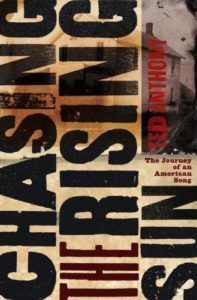
Ted Anthony wrote a definitive book onRising Sun chosenChasing the Rising Sun.In it, his journeying in search of the truthful birth of the song take him to a dozen states and even across the Atlantic bounding main. The book expertly discusses Rising Sun equally a role of the greater story of the spread of folk music at large. Anthony presents several ways songs tended to movement across the confining borders of small towns where many of the folk singers, both recorded or otherwise, lived their entire lives and died. Anthony asserts that Clarence Ashley actually traveled the Appalachia area in the 1920s with medicine shows. Medicine shows, popular in the early-to-mid 1900s, were traveling bands of musicians and salesmen. In a new boondocks, the musicians would sing songs to entertain and draw crowds, and the salesmen would take advantage of the gathering to sell bottled "medicine", (which could oftentimes improve exist described every bit flavored alcohol!) Information technology was these early traveling shows that helped untold numbers of folk songs spread. Clarence, as well equally unknown others, may have sang the famousFirmto numerous towns in Appalachia, where some townsfolk would remember and re-sing the song fourth dimension and again, improvising if they forgot a word or phrase.
Early folk songs such as Rise Sunwere also spread through the railroads. These were times when the only practical means of travel beyond long distances, which sometimes fifty-fifty meant 100 miles or less, was by train. It was also a time when train lines were still largely beingness congenital across America, with many workers singing in unison as they laid runway lines into and from various towns. This tin can be evidenced in many of both Alan Lomax and his male parent, John's folk recordings, where dozens of workers tin be found singing in unison — and sometimes harmony — to the melody of their hammers hit railroad spikes. Anthony describes a situation where he found a version of Firm of the Rising Lord's day, in Oklahoma. Though the "business firm" was not the called the Rising Sun but another, more localized infamous establishment, and the lyrics were changed slightly, the song was nonetheless obviously of the school of the "original". It was likely the railroads, theorizes Anthony, that would enable some anonymous soul to carry the song from the mountains in the east all the way to the plains in the midwest.
As records became more pop, so did recordings of the House of the Rising Lord's day. Instead of adventure hearing-and-remembering past mitt fulls of troubadours, records were common and fairly easy to come by. From the 1940s on, many artists recorded various versions of the song, occasionally under different titles, but generally the same lyrics and chord progressions. Leadbelly released several versions of the song in the 1940s. in 1958, Pete Seeger recorded a version on the banjo and, as was often common in before versions of the song, he sang it from the perspective of a woman. Woodie Guthrie recorded a version, as did both Joan Baez and Bob Dylan, who had arguably the most famous version until the Animals' cover several years afterwards. The Animals recorded their world-famous version in i accept during a May, 1964 recording session. Information technology became an immediate hit, and topped both the U.S. and U.Chiliad. single charts that twelvemonth. The song has been continuously been lauded for it's audio and staying power, and remained The Animals most pop single.
As for the location of theactual house of the Rise Sunday, it likely never existed in reality — despite the often-repeated instructions from French Quarter bout operators and passively tickled, often conflicting directions from many locals and well-meaning tourists akin. As Nola.com, a division of the Times-Little, reported in 2007, if a fabled Ascent Sunday e'erdidexist in New Orleans, currently the virtually likely location to claim the honor is located on 535-537 Conti St. in the famous French Quarter, where evidence of a hotel named Rising Dominicus was institute. Excavators discovered unusual amounts of makeup containers and liquor bottles, and a newspaper ad stating that the hotel was open to "discerning gentlemen", which could have possibly alluded to prostitution. Ascension Dominicus is idea to accept operated from 1808-1822, when information technology burned. The site is now a gallery for theHistoric New Orleans Collectionmuseum. Realistically, though, according to archaeologist Shannon Dawdy, who uncovered most of the artifacts, the hotel could just equally easily have been a hotel for men, which was non uncommon. It was also not uncommon for men of that era to apply some makeup to themselves, thus the bear witness is not sufficient enough to be definitive by any means.
There take been tales of a pic of a women's prison outside of New Orleans with a stone etching of a rising sun over the gate, though no images have surfaced to appointment. The theory is plausible, since most versions before the 60s made the narrator a adult female, and many renditions include the phrase "brawl and chain". A business firm on Esplanade Ave, just beside the French Quarter in the Treme neighborhood has, at times, been referenced as being "the" Rising Sun, equally have several other places in the area. In all actuality, the term "Rising Sun" was and continues to exist (no doubt fueled, in part, by the song'due south staying power and popularity, bringing it full-circle,) a common phrase. Different, interchanged versions of the song from across the state have been known to substitute New Orleans for another town, and the Ascent Sun for a dissimilar establishment, aiding in muddying fifty-fifty the city and state, allow lonely exact street or building. Often times the institution is a brothel, or a gambling parlor, bar, or prison. Many of the earlier singers probable never visited New Orleans, certainly 16 year old Georgia Turner did not, and the house of the Rising Sunday could merely as easily be a ingemination which ways whatever generic identify of ill repute. In truth, it will likely never be definitively known.
At that place has been evidence to advise that the song, though information technology'south origins are commonly traced dorsum as far as the early 1900s Appalachia area, has strong roots dozens or even hundreds of years before in England. Every bit many people over the years churned and moved and settled, the places that components of the song could accept come from are nearly endless. Much like hundreds of other folk songs, the epicenter ofHouse of the Rise Sun is lost to the by. It was a vocal that was passed from person to person and from one generation to the next. Information technology's earliest singers, the location of the house that then many had apparently spent their lives in sin and misery, and most everything else about the song is a mystery. Perhaps this mystery, forth with the somewhat anonymous lyrics and spooky small-scale chords, is part of what has continued to intrigue and then many thousands and millions over the years.
Chasing the Ascent Lord's daypast Ted Anthony on Amazon
Our Singing Country: Folk Songs and Ballads
Alan Lomax, Dover Publications, 1941
THE Ascent SUN BLUES
e. No. 1404. Georgia Turner, Middlesboro, Ky., 1937-Other stanzas, Bert Morton, Manchester, Ky., No. 1496.There is a business firm in New Orleans they call the Ascent Sun,
It'due south been the ruin of many poor girl, and me, O God, for 1.If I had listened what mama said, I'd'a' bee at home today,
beingness so young and foolish, poor boy, let a rambler lead me astray.Go tell my baby sister never to do like I have done,
To shun that house in New Orleans they call the Rising Lord's day.My mother she'southward a tailor, she sold those new blue jeans,
My sweetheart, he's a boozer, Lord, Lord, drinks downwardly in New Orleans.The but thing a drunkard needs is a suitcase and a body.
The only time he's satisfied is when he's on a drunkFills his glasses to the skirt, passes them effectually.
The only pleasance he gets out of life is hoboin' from town to boondocks.One pes is on the platform and the other on on the train,
I'm going back to New Orleans to wear that ball and chain.Going dorsum to New Orleans, my race is almost run,
Going dorsum to spend the residual of my life below that Ascension Sun
carrollfortionle64.blogspot.com
Source: https://www.americanbluesscene.com/2011/11/a-brief-history-of-house-of-the-rising-sun/
0 Response to "And Were Riding in the Sun Again"
Enregistrer un commentaire